


Core Manufacturing Steps
Sep 17, 2026
Leave a message
Core Manufacturing & Tensioning – The Backbone of Every Blade
Most buyers focus on the segment - the diamonds, the bond, the cutting edge. But the steel core is what holds everything together. A poorly made core will wobble, warp, or fail - no matter how good the segments are. Understanding core manufacturing and tensioning helps you choose blades that run true, cut straight, and last longer.
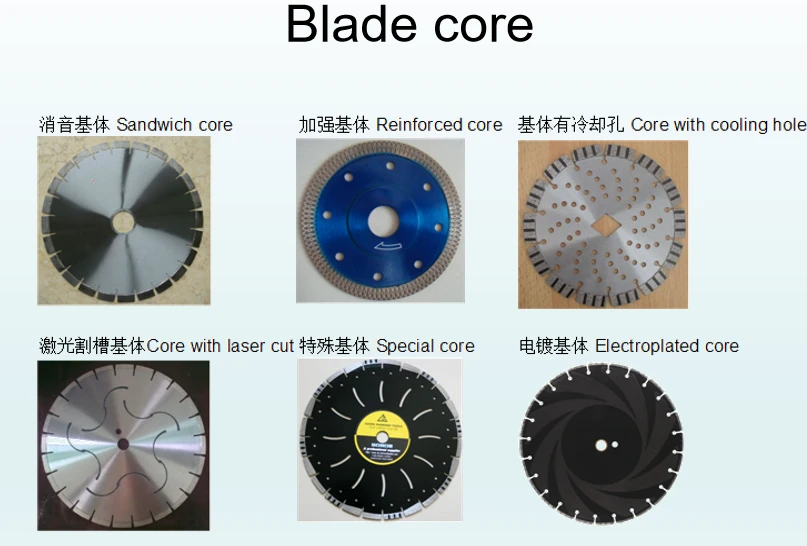
What Does a Core Do?
The steel core of a diamond blade has three essential jobs:
Support - Holds the segments firmly in place
Power Transmission - Transfers rotational force from the saw to the cutting edge
Stability - Keeps the blade running true at operating speed
Core Manufacturing Steps
| Step | Process | Purpose |
|---|---|---|
| 1 | Steel blank cutting | Create rough disc shape |
| 2 | Heat treatment | Strengthen the steel |
| 3 | Precision grinding | Create flat, smooth surface |
| 4 | Tensioning | Set flatness at operating RPM |
| 5 | Arbor hole machining | Ensure accurate fit on saw spindle |
Higher-quality blades use thicker cores with full heat treatment and precision grinding - essential for heavy-duty applications with high horsepower saws.
What Is Tensioning?
Tensioning is the process of applying controlled stress to the core so that it runs perfectly flat at its rated operating speed. It's a specialized skill - often done by hammering or rolling specific areas of the core to create compensating stresses.
Why tensioning matters:
A blade that is under-tensioned will flutter and wobble at speed
A blade that is over-tensioned will dish or warp
A properly tensioned blade runs flat, cuts straight, and resists binding
Core Thickness by Application
| Application | Core Thickness | Features |
|---|---|---|
| Tile cutting | 1.0 – 1.6 mm | Thin, flexible |
| General construction | 1.8 – 2.4 mm | Standard, balanced |
| Heavy demolition | 2.5 – 4.0 mm | Thick, heat-treated, precision-ground |
Important: Thicker cores are not always better. A core that's too thick for your saw creates unnecessary drag and requires more horsepower. Match core thickness to your equipment.
Signs of Core Problems
| Problem | Likely Cause | Solution |
|---|---|---|
| Blade wobbles at speed | Incorrect tensioning | Replace with properly tensioned blade |
| Blade warps during cutting | Overheating / loss of tension | Reduce feed pressure / improve cooling |
| Cracks near arbor | Metal fatigue / overuse | Replace blade immediately |
| Uneven cut | Bent core | Professional straightening or replace |
One Final Reminder
The core is the most overlooked component of a diamond blade - but it's the one that determines whether the blade runs safely and cuts accurately. When choosing a blade, look beyond the segment. Ask about the core. A great segment on a poor core is a poor blade.
Want to learn more about our core manufacturing and tensioning process? Contact the Diaflex technical team.